


Revised draft environmental review of proposed Chehalis River Basin Flood Damage Reduction Project

We closed the public comment period on the revised draft environmental impact statement Feb. 4, 2026
During the comment period, Ecology held several public meetings, online and in person. You can find links to meeting recordings and transcripts below:
- Dec. 11, 2025, virtual public hearing | recording - transcription
- Jan. 6, 2026, public hearing | transcription
- Jan. 8, 2026, virtual public hearing | recording - transcription
- Jan. 13, 2026, public meeting | transcription
- Jan. 21, 2026, public meeting | transcription
What was the Revised Draft EIS about?
We analyzed potential environmental impacts of the proposed Chehalis River Basin Flood Damage Reduction project. The project explores ways to reduce the severity and duration of major and catastrophic floods that occur in the Chehalis River basin in southwest Washington. Proposed by the Chehalis River Basin Flood Control Zone District (Flood District), the project recommended two actions:
- Constructing a unique flow-through dam and associated temporary reservoir on the Chehalis River near the town of Pe Ell.
- Make changes to the Chehalis-Centralia Airport levee.
We analyzed potential project impacts and released a revised draft environmental impact statement that outlined our findings to gather public comments. We are currently reviewing comments and will finalize the environmental impact statement this summer.
The revised draft environmental impact statement is not a decision-making document. It does not approve or deny the proposal. Instead, it provides critical information for decision-makers to consider.

What happens now that the comment period is over?
We will review and consider all the comments we receive and prepare a final environmental impact statement for the proposed project. We will weigh all comments equally, regardless of how they were submitted to us (verbal, written or online).
We anticipate publishing a final environmental impact statement for the project in late summer 2026. A response to comments will be attached to the final environmental impact statement.
The final study will also inform permit decisions that will be made if the project moves forward. If the project moves forward, the Flood District anticipates starting construction in 2030.
Background
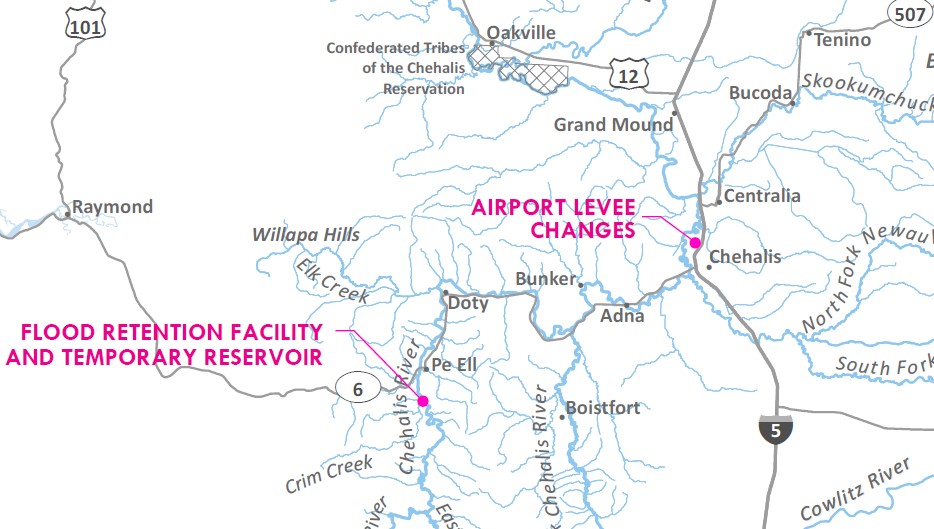
Location of the proposed flood retention facility and temporary reservoir and airport levee. Click image to download full version of map.
The Flood District originally proposed the flood damage reduction project with a different design a few years ago. We conducted a draft environmental review of that original design and held a public comment period in 2020. However, in the five years since our first draft environmental review, the Flood District changed the location, design, and construction details for its proposal, and resubmitted an updated proposal to us in April 2024. We determined the changes were significant enough to revise our original draft environmental impact statement for the project.
The revised draft environmental impact statement does not compare the two designs. It only looks at the new design, its potential environmental impacts, and possible measures to mitigate or offset any environmental impacts.
What our revised draft environmental study found
We used scientific models to help understand, test and predict how the proposed project would impact the environment. We found there would be adverse environmental impacts at the site of the dam structure, in the temporary reservoir area, and in areas downstream from the proposed dam during construction and operation.
The revised draft environmental impact statement found constructing and operating the flow-through dam and temporary reservoir would significantly and negatively impact fish and wildlife as well as aquatic and land habitats, recreation, earth, water, transportation, wetlands, land use, Tribal resources, cultural resources, environmental health and safety, environmental justice, and public services and utilities.
Fish impacts
Our modeling data shows the proposed flow-through dam facility would adversely impact salmon and steelhead trout populations, especially near the structure. Our modeling also predicts climate change will continue to cause salmon and steelhead trout populations in the Chehalis River basin to decline, and the proposed dam is likely to magnify these adverse impacts.
Modeling also predicts the proposed project would reduce the genetic diversity within and among spring- and fall-run Chinook salmon runs as well as coho and chum salmon populations in 3,400-square-mile Chehalis River drainage system. We would also see significant adverse impacts to steelhead trout, lamprey, mountain whitefish, freshwater mussels, amphibians and macroinvertebrates such as insects, worms, snails and crayfish.
Tribal and cultural resources impacts
Based on available information, the proposed project would significantly impact Tribal cultural and natural resources.
Wildlife impacts
The project would significantly impact on wildlife species, their habitats and associated vegetation during construction and operation. Once operational, the proposed dam structure and associated temporary reservoir would block migratory pathways for wildlife.
Earth impacts
We found landslide risks around the temporary reservoir area. The project would also change the river channel and how neighboring sediment moves.
Water impacts
We found the proposed project would reduce the amount of streamside vegetation and shade cover along the Chehalis River and streams near the project. This would degrade area water quality by raising stream temperatures and reducing dissolved oxygen levels(which impacts fish). In addition, the project would eliminate peak downstream flows that are critical for forming natural channels that help slow down flood waters and create habitat areas for fish and other aquatic life.
Finally, the project would also reduce conditions favorable for replenishing large woody debris in basin rivers and streams. Large woody debris helps slow erosion and provides habitat areas for salmon and other aquatic species. In addition, wetlands, streams, and their buffers would be significantly impacted by dam construction activities and by operating the temporary reservoir.
Federal environmental review process also underway
The U.S. Army Corps of Engineers is conducting a separate federal review of the Flood District’s proposal under the National Environmental Policy Act. We will continue to coordinate with the Flood District, other state agencies and the U.S. Army Corps of Engineers during the review. However, the SEPA and NEPA processes will remain separate and on different schedules.
Details about the Flood District's proposed project
The Flood District’s proposed project entails building a unique flow-through dam and associated temporary reservoir on the Chehalis River near the town of Pe Ell and making changes to the Chehalis-Centralia Airport levee.
Under the Flood District’s proposal, the Chehalis River would flow freely through the dam structure unless a catastrophic or major flood occurs in the upper Chehalis River basin, triggered by heavy precipitation in the Willapa Hills. The dam would then close its gates to temporarily hold back flood waters to reduce flood-related damage from Pe Ell to Centralia. Water would be safely released later. The project is not intended to address flooding in all parts of the Chehalis River basin and would not stop regular annual flooding.
What changes were made to the original project proposal?
The Flood District made several key changes to its original proposal, in response to our findings in the 2020 draft environmental impact statement including:
- Moving the dam structure about 1,000 feet upstream from its original location.
- Revising plans so fish could pass through the site before and after construction.
- Submitting a plan to manage vegetation.
- Identifying new construction quarry sites and updating information about roads proposed to be used during dam construction.
- Making minor updates to the proposed airport levee portion of the project.
- Drafting mitigation plans that address how adverse environmental impacts from the proposal could be offset.
Does the revised draft study connect to the Chehalis Basin Strategy?
The independent Chehalis Basin Board is leading the development of the Chehalis Basin Strategy—the long-term action plan for reducing flood damage and restoring salmon and other aquatic life in the Chehalis River basin. The board is considering a combination of projects and investments and is working on recommendations to present to the Washington Legislature in 2026 to move the strategy forward. The board will consider the information in our environmental review as they make decisions about the long-term strategy.
Climate change integrated into findings
We integrated climate change in our analysis of future conditions for the location where the proposed flood retention dam would operate. Unless Washington sees significant restoration efforts, climate change will drive more frequent floods, higher flood levels, and would put native fish runs at higher risk in the future.
Revised, draft study also analyzes two other alternatives
In addition to the proposed project, our revised draft environmental impact statement also analyzed what is known as a "no action" alternative. This analysis examines what would happen if the applicant doesn’t build the flood retention facility, or if we don’t see any improvements made to the airport levee. The study also analyzed a “local actions” alternative based on localized and nonstructural actions that could help retain floodwaters and reduce flood-related damage.
Calendar
| Review process | Year | Details |
|---|---|---|
| Revised SEPA Draft Environmental Impact Statement | 2025 | Detailed analysis of the revised proposal for a flow-through flood control dam and airport levee changes. |
| SEPA Draft Environmental Impact Statement | 2020 | Detailed analysis of the flood retention facility and levee changes. |
| NEPA Project level review | 2020 | Detailed analysis of the flood retention facility and levee changes. |
| SEPA scoping for the EIS | 2018 | Comment period to collect information about what to include in the EIS. |
| SEPA Programmatic review | 2017 | High-level consideration of possible flood-reduction options. |
SEPA findings, administrative process questions
Contact information
Environmental review:
Meg Bommarito
EIS Project Manager
meg.bommarito@ecy.wa.gov
425-681-6236
Media contact:
Curt Hart
Communications Manager
curt.hart@ecy.wa.gov
564-250-2126