




Rayonier Mill cleanup
Rayonier mill in operation, 1990s.
We are working toward a safer, cleaner waterfront and harbor in Port Angeles with the Rayonier Mill cleanup. It is one of several cleanup projects near Port Angeles Harbor.
Decades of industrial activity at the former Rayonier Mill contaminated the water and sediments of the harbor and the soil around the mill. Rayonier A.M. Properties LLC (RAMP) is working under our oversight to study and clean up that contamination. We also work with Tribal representatives and many stakeholders to move cleanup forward in a way that considers the larger Port Angeles community.
This cleanup is a long, complex undertaking. We are committed to doing thorough work that upholds Washington’s laws and high standards to protect human health and the environment.
Public involvement
Public input is part of Washington’s cleanup process. We ask for comments from the public on key studies and planning documents.

Stay in the loop! Sign up to get an email when there is an opportunity to get involved.
Recent public involvement
In 2025, we asked for public comments on three documents:
- Consent decree
- Interim Action Plan
- State Environmental Policy Act (SEPA) Determination of Nonsignificance
We received a lot of feedback. We reviewed each comment, identifing the major topics of concern. We then evaluated commenters’ requests, questions, and concerns. For example, in response to public input, Ecology re‑analyzed the associated disproportionate cost analysis.
There is more information on our reponses to comments and the outcomes of the public comment period in the 2026 Responsiveness Summary. The six-page Port Angeles Rayonier Mill Cleanup Project Updates gives an overview of the comment period and updates on the cleanup’s progress.
The Rayonier cleanup study area
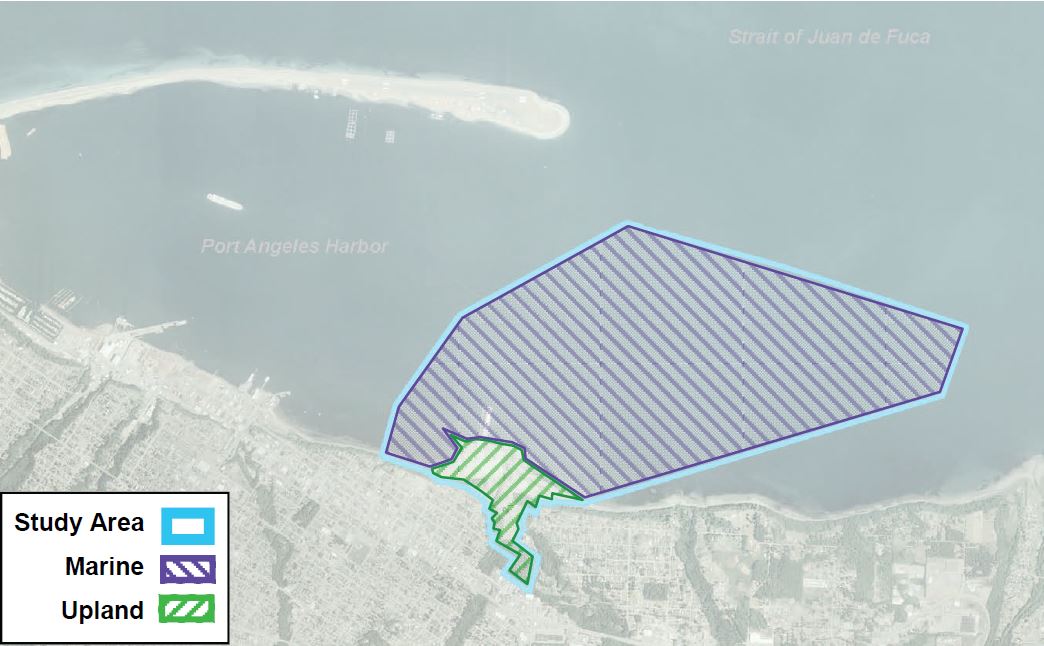
Rayonier Mill cleanup upland and marine study areas.
We define cleanup sites by the extent of contamination. Because we don’t yet know how far contamination from the mill spreads, we don’t know the formal boundaries of this cleanup site. Currently we are focused on a study area that includes:
- Property owned or leased by RAMP (uplands area)
- Marine sediments next to the RAMP property (marine area)
Investigating the study area is RAMP's responsibility. After completing the cleanup in the study area, we will investigate contamination beyond the study area to draw site boundaries that clearly define responsibility for the rest of the cleanup.
Who is financially responsible for the cleanup?
Under MTCA, current owners or operators of contaminated property as well as owners and operators at the time of contamination may be named as potentially liable persons. Rayonier, Inc. owned and operated the Rayonier Mill and was named a potentially liable person in 2001. In 2004, Rayonier, Inc. conveyed property ownership to Rayonier Properties, LLC, a wholly owned subsidiary, which Ecology named a potentially liable person in 2009. When Rayonier, Inc. split into Rayonier, Inc. and Rayonier Advanced Materials (RYAM) in 2014, the subsidiary moved to RYAM and was renamed Rayonier A.M. Properties LLC (RAMP). As a result, RYAM and RAMP are the potentially liable persons for the site.
We use “Rayonier, Inc.” when referring to activities that occurred prior to 2014. We use RAMP when referring to activities after 2014 as well as current and future obligations for implementing cleanup, and we use “former Rayonier Mill” when referring to the site.
Environmental concerns
Until the 1970s the mill released untreated wastewater from the pulp-making process into Port Angeles Harbor. The mill also burned seawater-soaked wood in the hog fuel boilers. The smoke from the boilers carried pollutants, including dioxins. Other industrial chemicals were released into the environment as well.
The mill started treating its wastewater in the 1970s. After this, it released less pollution into the harbor.
We found these pollutants in the study area:
- Petroleum hydrocarbons, such as hydraulic or fuel oil
- Polychlorinated biphenyls (PCBs) from electrical equipment
- Lead from a lead-based mortar between bricks inside part of the mill
- Dioxins and furans from boiler emissions and ash
- Arsenic
We also found dioxins and furans in off-property areas.
Initial cleanup progress
Near the beginning of the cleanup process, RAMP and Ecology found many cleanup activities that could move forward quickly. Before the long process of planning further actions began, we made some meaningful progress.
Early cleanup actions
Between 1993 and 2006, Rayonier, Inc demolished buildings, removed contaminated material, and filled in soil pits with clean soil. Early partial cleanups like this are called “interim actions.” They’re designed to quickly address areas with the highest contamination. These quicker cleanups help keep contamination from spreading.
Rayonier, Inc has already removed over 30,000 tons of contaminated material from the site. Through interim actions, Rayonier, Inc removed:
- Over 24,000 tons of petroleum-contaminated soil and concrete (that’s about 40 football fields covered with a foot of soil).
- 2,700 cubic yards of petroleum-contaminated wood residue left from the hog fuel pile.
- 2,500 sunken logs from the log pond.
- 4,800 tons of soil from the spent sulfite liquor lagoon.
You can read more about this work in the 2006 Interim Action Report and the 2003 Interim Action Report.
Studying before the final cleanup
Before we can plan an effective cleanup, we need to know about the kinds of contamination and where they are. We take time to research a site and plan its cleanup because we want to ensure cleanup is done right.
As the overseeing authority, it is important for us to be able to request major changes to reports and plans if they don’t meet our standards. Over the course of this cleanup, we’ve had updates to state laws and cleanup standards that required significant revisions to prepared documents and plans. We have also extended the timeline to adjust to major changes in the Sediment Management Standards, which significantly changed our approach to cleanup in Port Angeles Harbor.
We have done many studies on the study area and surrounding areas. To learn more, see Studying Rayonier Mill: What we've learned.
Cleanup is moving forward
The Rayonier Mill cleanup has reached a major milestone: the study area is now in the “Design the cleanup” phase. RAMP has hired consultants to complete final sampling work, which will help refine the boundaries of the cleanup areas. Using this information, RAMP will prepare an engineering design report. Ecology will continue to provide close oversight of all sampling, data collection, and analysis.

Steps in the cleanup process.
The design work will likely be done in phases. First there will be studies, and the resulting data will be used to develop detailed engineering reports and cleanup designs. There aren't usually public comment periods during the “Design the cleanup” or “Clean up the site” steps. However, Ecology will continue to share updates on the design work and overall cleanup progress. Community members are always welcome to share their thoughts, concerns, and priorities with Ecology at any point.
When will cleanup be finished?
We recognize that progress has been slow, and we hear the community’s desire for a faster cleanup. Like the Port Angeles community, we are eager to start construction. Once the engineering designs are finalized, cleanup construction (“Clean up the site!”) will begin. In total, the soil cleanup is expected to take no more than 7 years, while groundwater and sediment cleanup efforts are expected to take no more than 10 years. This work will mostly be in parallel, so the overall restoration timeframe for the project — including the design, permitting, contracting, construction, and implementing institutional controls — is expected to be no more than 10 years. As design progresses, new data may further refine these estimates.
Once cleanup construction is completed, the Port Angeles Rayonier Mill study area will be safe for the community and environment, and ready to be put back into productive use. Ecology is not involved in selecting or implementing future land uses; these decisions rest with the property owner and local government.
Contact information
Marian Abbett, P.E.
Section Manager
Marian.Abbett@ecy.wa.gov
360-489-4569