


Benefits of the Clean Fuel Standard
The Clean Fuel Standard will reduce greenhouse gas emissions from transportation fuels, improve air quality, and make low-carbon fuels more affordable and available.
Reduce greenhouse gas emissions
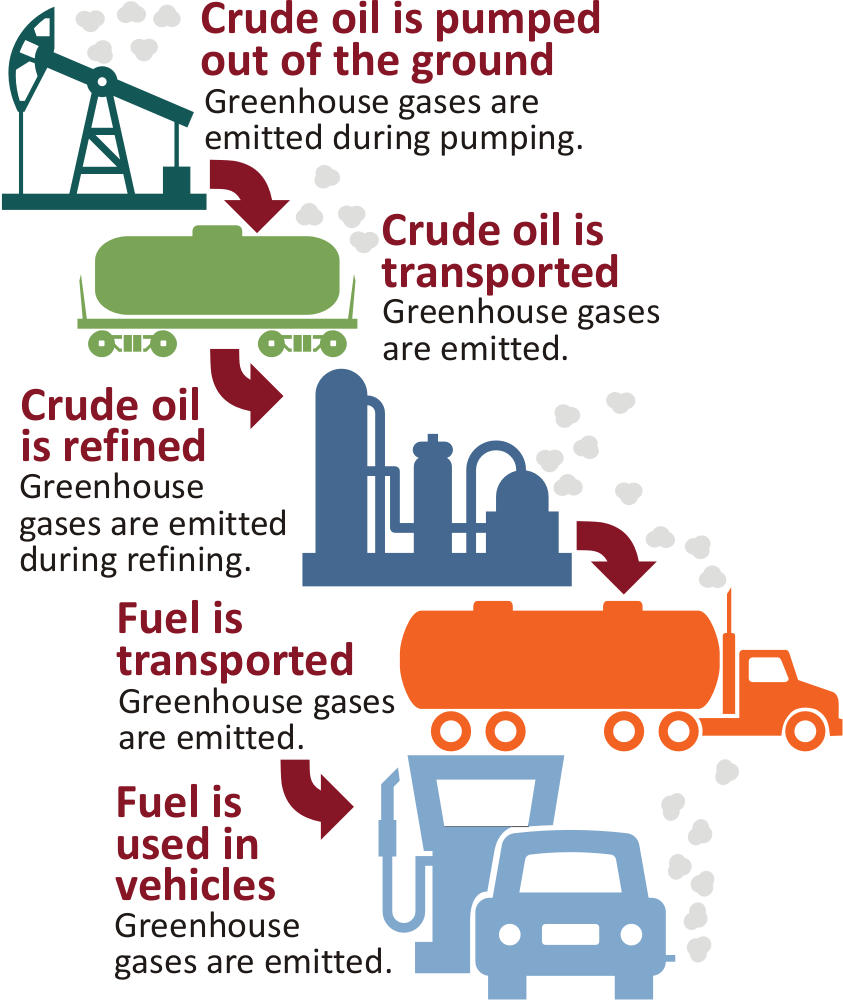
The lifecycle of gasoline and diesel fuels
The Clean Fuel Standard program will reduce greenhouse gas emissions associated with the full life cycle of transportation fuels before it reaches a vehicle. Transportation is Washington's biggest source of greenhouse gas emissions. As of 2019, the transportation sector contributed 39% of Washington’s greenhouse gas emissions.
Reducing these emissions will help lessen the effects of producing and using transportation fuels on Washington residents' health and the environment, including air quality, snowpack, and coastline.
By looking at emissions over the life cycle of each fuel, the program aims to fully capture the greenhouse gas impact of producing and using each fuel.
Improve air quality
Transportation fuels — such as gasoline and diesel — emit harmful air pollution that causes health issues, especially for communities living near high-traffic areas. By transitioning to lower carbon fuels, the Clean Fuel Standard will also reduce those harmful pollutants and help residents breathe easier.
The Clean Fuel Standard is estimated to save up to $40 million per year by reducing our contribution to climate change — and the wildfires, floods, storms, and other natural disasters that come with it.
The cost-benefit analysis found that, once fully phased in, the Clean Fuel Standard — combined with other transportation initiatives — will mean an estimated $1.8 to $3.8 billion in economic benefit, due to better health and reduced health care costs.
Increase fuel choices
By increasing the use and availability of low carbon fuels in Washington, the Clean Fuel Standard will increase consumer fuel choices while reducing risk of price spikes in the global fossil fuel market.
Utility investments
The Clean Fuel Standard requires electric utilities to use a portion of the credit revenue in communities with the most air pollution. The credit revenue is generated by selling electricity to charge electric vehicles.
We are working with the Washington Department of Transportation to determine eligible project types for this reinvestment. Electric utilities will report to us about their reinvestment activities.
Oregon's Clean Fuels Program has examples of similar utility investments.
Backstop aggregator
On May 31, 2023, we designated Forth Mobility Fund as the backstop aggregator.
A “backstop aggregator” is a non-profit organization appointed to:
- Collect unclaimed credits from electric charging.
- Sell those credits.
- Reinvest the revenue into transportation electrification in communities with the most air pollution.
Economic development
The Clean Fuel Standard will spur economic development in producing and supplying low carbon fuels. This means technological innovation, job growth, and opportunities for Washington businesses.
Washington businesses are already major suppliers of clean, low carbon fuels, including biodiesel and renewable natural gas. However, most of those fuels are sold out of state — taking their emissions benefits with them. The Clean Fuel Standard statute has several provisions designed to expand the supply of clean fuels produced in Washington, including:
- Requiring a 15% net increase in in-state liquid biofuel production in Washington.
- Completing permitting approval for a new or expanded biofuel production facility with at least 60 million gallons of annual capacity, including at least 10 million gallons of annual capacity in a new facility.
These requirements must be met before the carbon-intensity standard can be reduced beyond 10%.
Related links
Contact information
Abbey Brown
Clean Fuel Standard Technical Lead
cfs@ecy.wa.gov
360-819-0158
Stay informed
Join our email list