


Clean Water Guidance Advisory Group
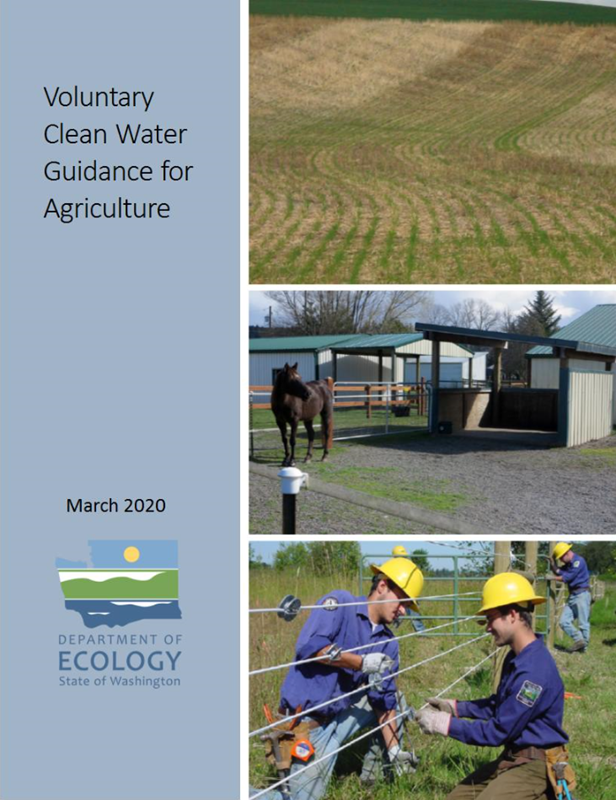
We are working with an advisory group to research and write Voluntary Clean Water Guidance for Agriculture (Clean Water Guidance). This guidance document will be a technical resource for agricultural producers that recommends best management practices (BMPs) to protect water quality. It is intended to support healthy farms while helping producers meet clean water standards.
As we work on the guidance, we are issuing collections of chapters for public review. In 2022, after taking public comment, we submitted the first set of chapters to EPA for approval. These chapters are a part of our 2022 nonpoint plan. We plan to complete the next set of chapters, listed below, by the end of 2025. We will provide opportunities for public review once the chapters are reviewed by our advisory group.
To learn more about any current comment periods and the nonpoint plan please visit the Nonpoint Plan webpage
Please read our Voluntary Clean Water Guidance for Agriculture focus sheet to learn more.
Advisory group
We established the Voluntary Clean Water Guidance for Agriculture advisory group to advise us on the identification and implementation of practices that support healthy farms and help farmers to meet clean water standards. We reached out to a wide range of stakeholders to find qualified candidates to be a part of the advisory group. Advisory group members assist in the development of the guidance, provide review and feedback, and contribute to the guidance document’s ultimate success.
More information on how we approach developing the guidance can be found in the Process design document.
Chapters of the guidance
Visit our Nonpoint Plan and Guidance page for links to chapters, more information, and current comment periods.
Submitted to EPA for approval
- Cropping Methods: Tillage & Residue Management
- Livestock Management — Pasture & Rangeland Grazing
- Sediment Control: Soil Stabilization & Sediment Capture (Structural)
- Riparian Areas & Surface Water Protection
- Livestock Management — Animal Confinement, Manure Handling, & Storage (submitted to EPA July 2023)
Future chapters to be complete by end of 2025:
- Cropping Methods: Crop System
- Nutrient Management
- Pesticide Management
- Sediment Control: Soil Stabilization & Sediment Capture (Vegetative)
- Water Management: Irrigation Systems & Management
- Water Management: Field Drainage & Drain Tile Management
- Water Management: Stormwater Control & Diversion
- Suite of Recommended Practices
Contact information
Ben Rau
Watershed Planning Unit Supervisor
ben.rau@ecy.wa.gov
360-742-6529