




Episodic generation of dangerous waste

Unplanned events require immediate action!
Email or fax us within 72 hours of an unplanned event. You must also report a spill if the unplanned event involves any amount of dangerous waste or hazardous substances.
Impacted by natural disaster?
Sites may qualify to manage dangerous wastes from natural disasters as an unplanned event. Notify us within 72 hours of your waste determination (not from the time of the disaster itself).
The episodic generation rules allow small and medium quantity generators to maintain their current generator category, even when larger-than-normal waste amounts are generated from qualifying episodic events. Using this rule is optional.
An episodic event is an activity, either planned or unplanned, that:
- Does not normally occur during generator operations.
- Results in an increase of dangerous waste that exceeds your generator category's monthly quantity exclusion limits (QEL).
You must also report a spill if:
- Any unplanned event involves spills of dangerous waste or hazardous substances.
- A spill poses a threat to human health or the environment, regardless of size.
Planned vs. unplanned episodic events
- Planned events are episodic events you planned and prepared for, such as tank cleanouts, short-term projects, or removal of excess chemical inventory.
- Unplanned events are unexpected episodic events, such as a production process upset, product recall, accidental spill, or "act of nature," such as a tornado, earthquake, flood, or wildfire.
You can manage waste from one event type per calendar year under this rule provided you notify us correctly and follow the instructions below.
How to notify Ecology of an episodic event
To manage your dangerous waste under the episodic generation rules:
- Get an EPA/State Identification Number (if you don’t already have one).
- Follow the requirements for your type of episodic event.
How to manage waste from an episodic event
Regardless of the type of episodic event, there are specific storage, disposal, and reporting requirements you need to follow.
Storage and labeling requirements
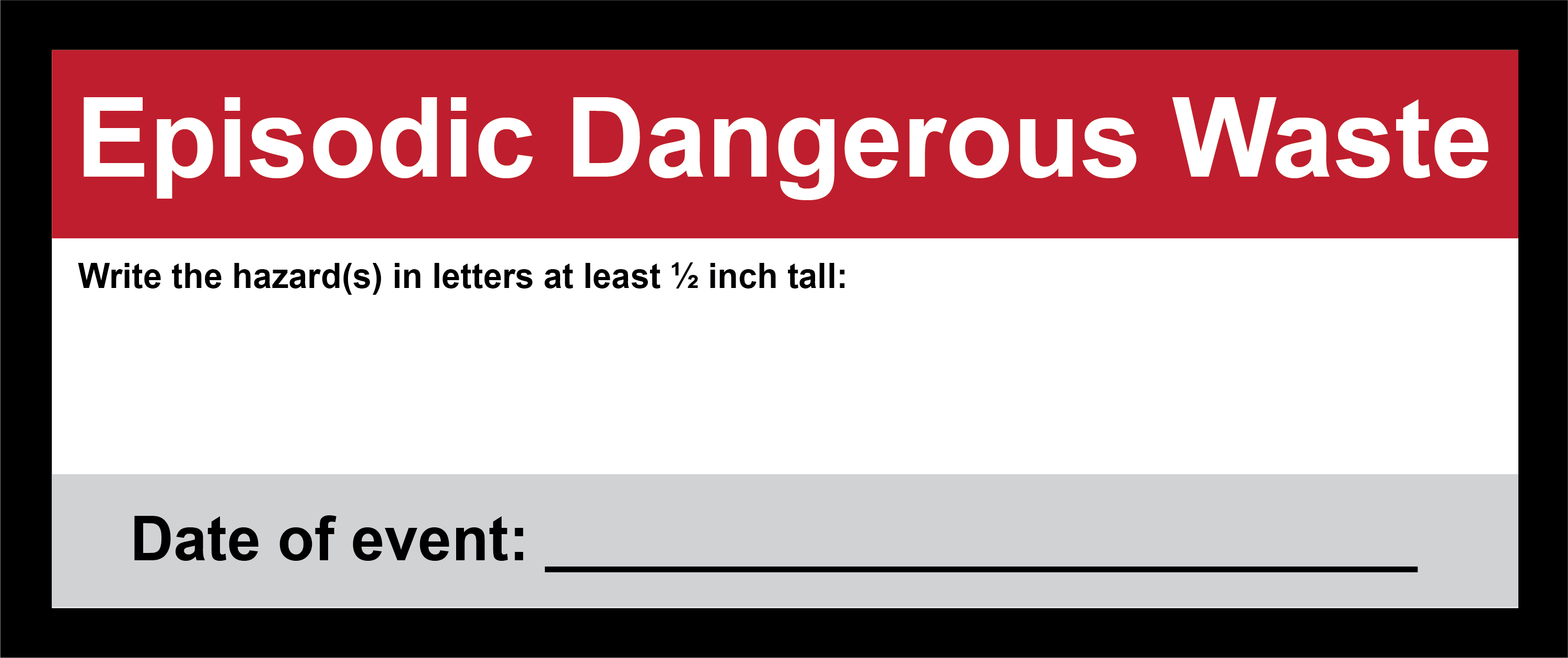
Click to print or download our free label.
Accumulate episodic waste in tanks and containers that are:
- In good condition and compatible with the waste.
- Kept closed (except when adding or removing waste).
- Labeled with “Episodic Dangerous Waste” or “Episodic Hazardous Waste,” hazards associated with the waste (e.g., ignitable, corrosive, reactive, toxic), and the episodic event start date.
Labels must be legible from 25 feet away or have letters at least 1/2 inch high. For one-gallon containers (four liters) or less, labels and lettering can be appropriate for the size of the container.
Disposal requirements
Send episodic waste to a treatment, storage, and disposal (TSD) facility within 60 calendar days from the start date of the event.
Note: Medium quantity generators (MQGs) can choose to treat episodic waste on-site within 60 calendar days from the event start date. All other generators must send episodic waste to a TSD.
Reporting requirements
Complete a Dangerous Waste Report for the previous year’s generation activity. You must report all episodic waste streams. While your generator category remains the same, episodic waste still counts towards the Hazardous Waste Planning Fee and Pollution Prevention (P2) Plan.
Frequently asked questions
Related links
Contact information
For unplanned events, email or fax your region within 72 hours.
What is your region?
Find out what regional office serves your county.
Southwest region
Stephanie Heiges
stephanie.heiges@ecy.wa.gov
Ph: 360-522-0532
Fax: 360-407-6989
Northwest region
Kylie Otani
kylie.otani@ecy.wa.gov
Ph: 425-758-7450
Fax: 206-366-7810
Eastern region
Alex Bergh
alexandra.bergh@ecy.wa.gov
Ph: 509-385-5539
Fax: 509-329-3572
Central region
Katherine Gauthier
katherine.gauthier@ecy.wa.gov
Ph: 509-406-6851
Fax: 509-575-2809